

What is the VBIT Framework?
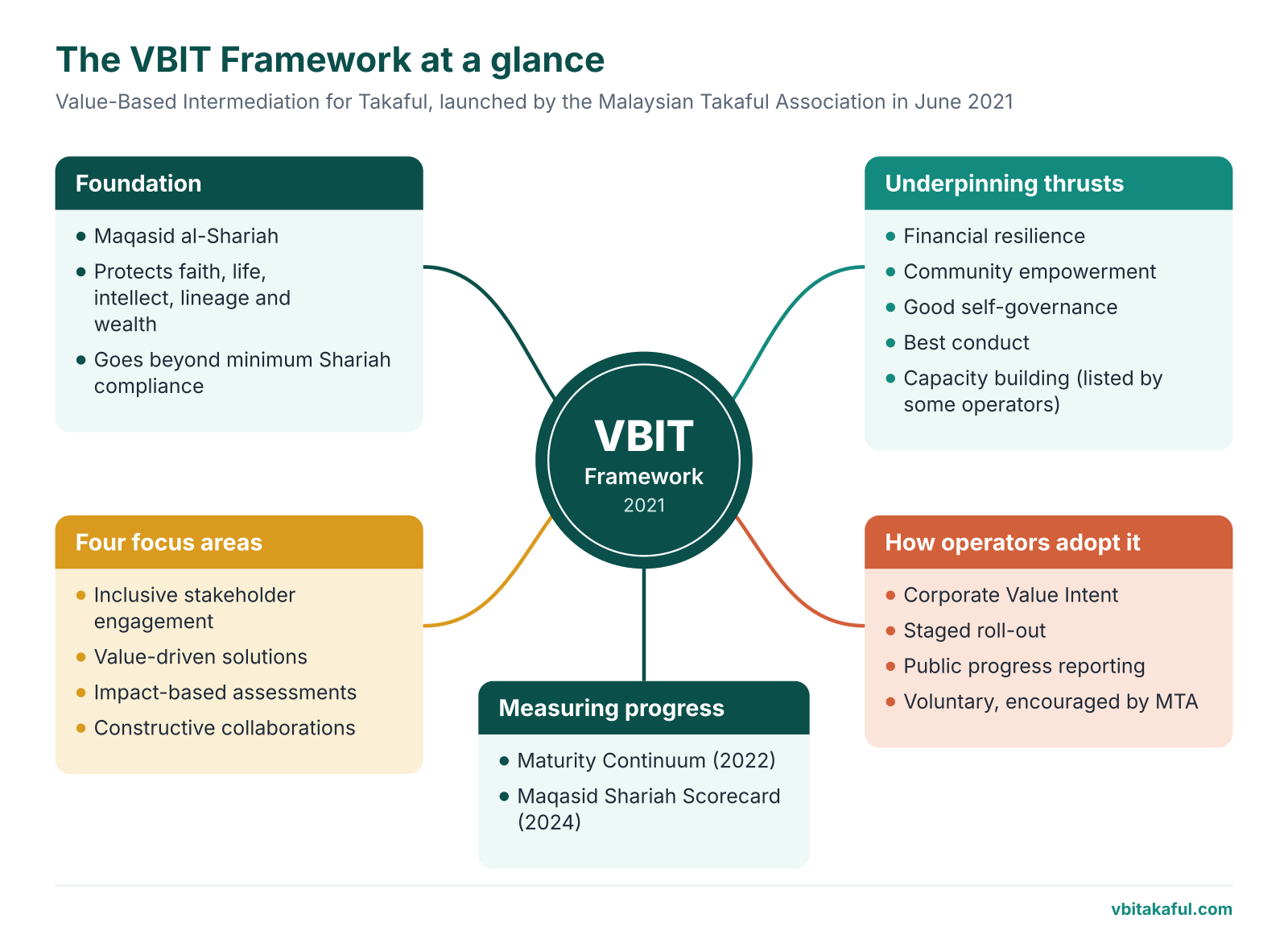
The VBIT Framework is the Malaysian takaful industry’s guide to doing takaful in a way that creates real value for people and society, not just meeting Shariah rules. The Malaysian Takaful Association (MTA) launched it on 23 June 2021. It applies to family takaful, general takaful and retakaful operators.
| At a glance | |
|---|---|
| Full name | Value-Based Intermediation for Takaful (VBIT) Framework |
| Issued by | Malaysian Takaful Association (MTA), the trade body for Malaysia’s 18 licensed takaful and retakaful operators (as at 2021) |
| Launched | 23 June 2021, at the JC3 Flagship Conference: #FinanceForChange |
| Builds on | Bank Negara Malaysia’s Value-Based Intermediation (VBI) strategy paper, 2017 |
| Applies to | Family takaful, general takaful and retakaful operators |
| Foundation | Maqasid al-Shariah, the objectives of Islamic law |
| Status | Voluntary industry framework, not a regulation |
| Follow-up | VBIT Roadmap, launched October 2022 |
About this guide: This is an independent explainer. It is not published by, or affiliated with, the Malaysian Takaful Association. For the official framework document, contact MTA through takaful4all.org.
From VBI to VBIT: where the framework came from
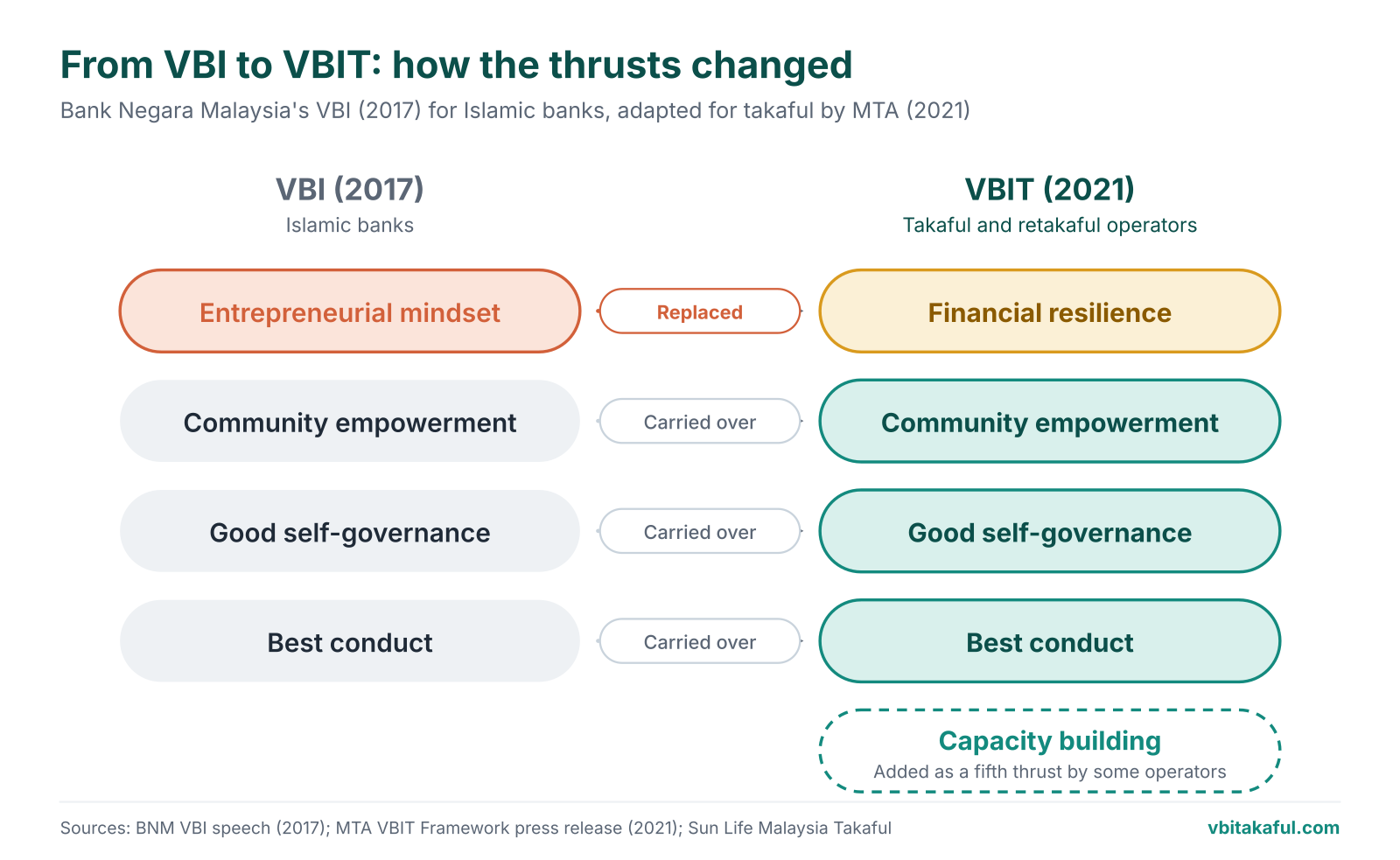
VBIT is the takaful version of Value-Based Intermediation (VBI), which Bank Negara Malaysia (BNM) introduced for Islamic banks in 2017. VBI asked Islamic banks to deliver the intended outcomes of Shariah through practices, conduct and offerings that create a positive, lasting impact on the economy, the community and the environment, while still giving shareholders sustainable returns.

VBI rested on four underpinning thrusts:
- Entrepreneurial mindset
- Community empowerment
- Good self-governance
- Best conduct
When BNM launched VBI in 2017, its deputy governor said the thrusts would in time be expanded to fit the takaful industry. That is what VBIT does. MTA developed it with its member operators and other stakeholders, and launched it in June 2021.
The biggest change is the first thrust. VBIT keeps community empowerment, good self-governance and best conduct, but replaces entrepreneurial mindset with financial resilience. That fits takaful’s core job: helping households and businesses absorb shocks such as illness, death, accidents and disasters.
Maqasid al-Shariah: the foundation of VBIT
VBIT is built on Maqasid al-Shariah, the higher objectives of Islamic law. The idea is to go beyond the minimum Shariah requirements and deliver the outcomes Shariah is meant to achieve. In takaful, that means safeguarding five essentials:
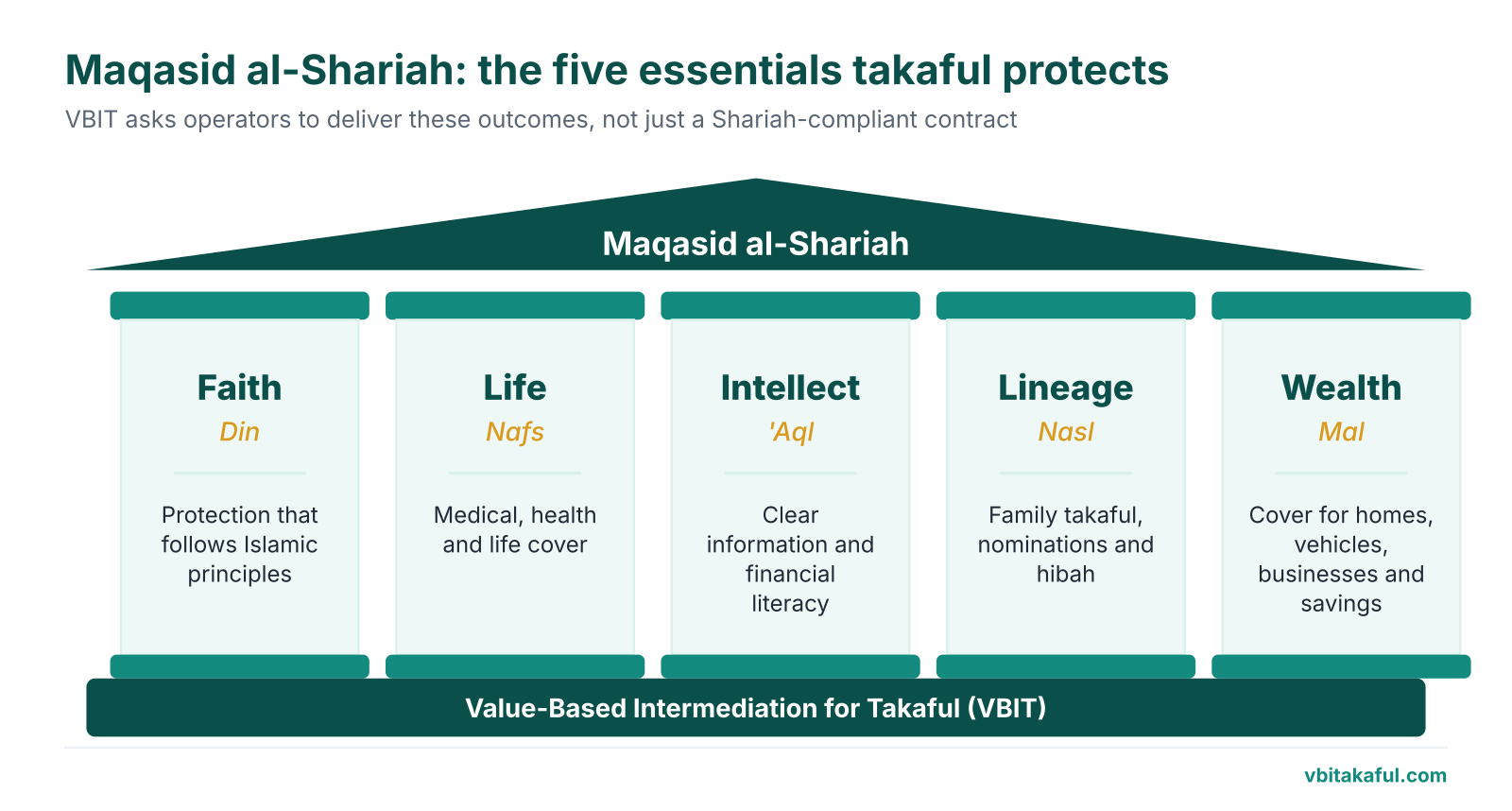
| Objective | What it protects | How it shows up in takaful |
|---|---|---|
| Faith (din) | Religion and belief | Protection that follows Islamic principles: mutual help, no interest, no excessive uncertainty |
| Life (nafs) | Health and life | Medical, health, critical illness and life cover |
| Intellect (‘aql) | Knowledge and the ability to decide well | Clear product information, financial literacy and education plans |
| Lineage (nasl) | Family and future generations | Family takaful, nominations and hibah so dependants are provided for |
| Wealth (mal) | Property, income and savings | Cover for homes, vehicles and businesses, plus savings features |
This is what separates VBIT from a purely commercial approach. A product can be Shariah-compliant on paper and still fail to protect these five things in practice. VBIT asks operators to check the outcome, not just the contract.
The VBIT underpinning thrusts
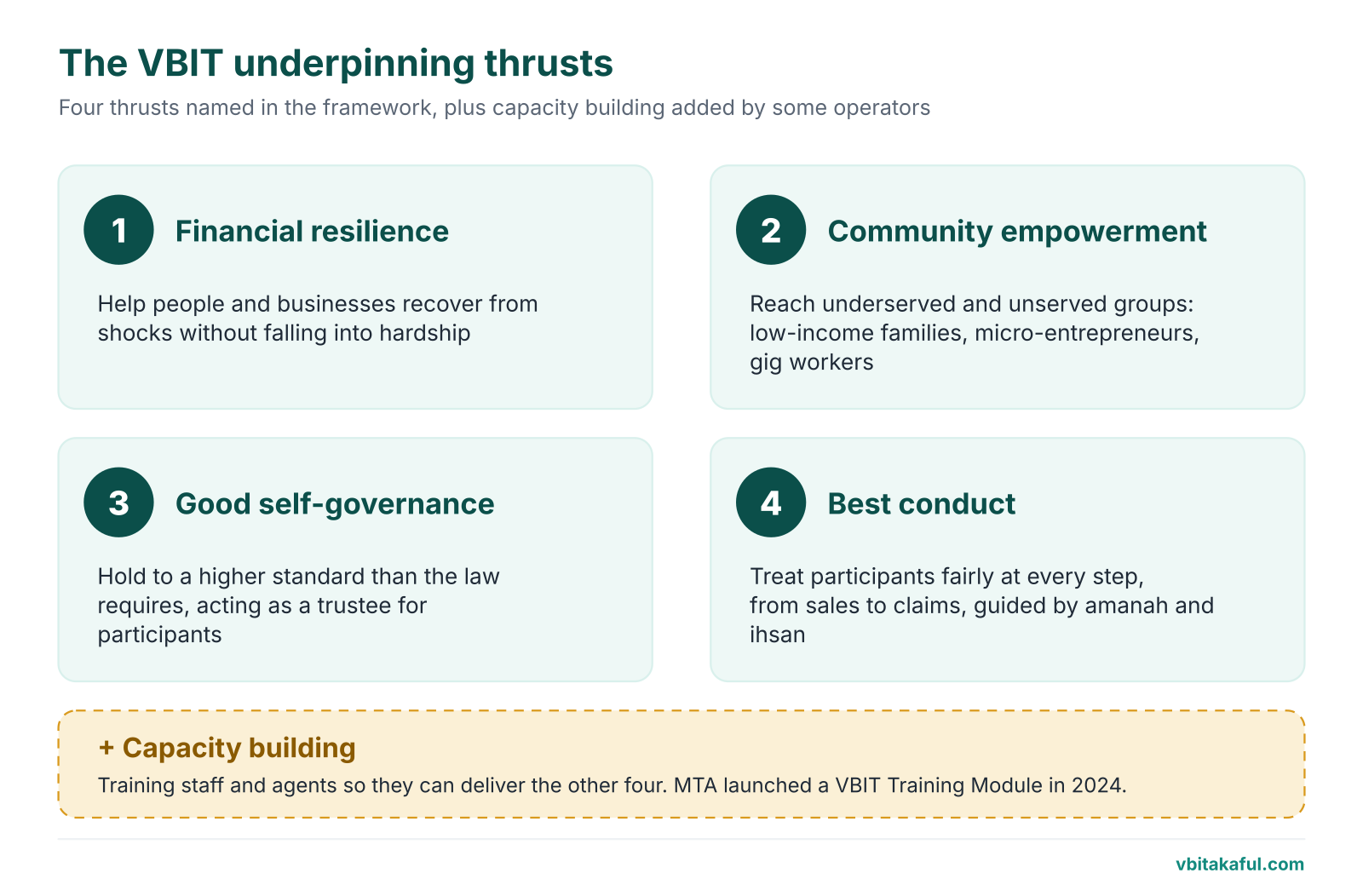
The framework names four underpinning thrusts: Financial Resilience, Community Empowerment, Good Self-Governance and Best Conduct. Together they describe what a value-based takaful operator should deliver.
1. Financial resilience
Takaful should help people and businesses recover from shocks without falling into hardship. MTA describes the aim as offering livelihood and financial assurance to the community. In practice, that means cover people can afford, keep up and actually claim on when they need it.

2. Community empowerment
This thrust is about reaching people the industry has historically missed. MTA’s goal at launch was inclusive protection for underserved and unserved segments of society. Examples include low-income households, micro-entrepreneurs and gig workers.

3. Good self-governance
Operators are expected to hold themselves to a higher standard than the law requires. BNM has described takaful operators as trustworthy managers (wakeel) with a fiduciary duty to participants. That calls for strong boards, Shariah oversight and control functions.
4. Best conduct
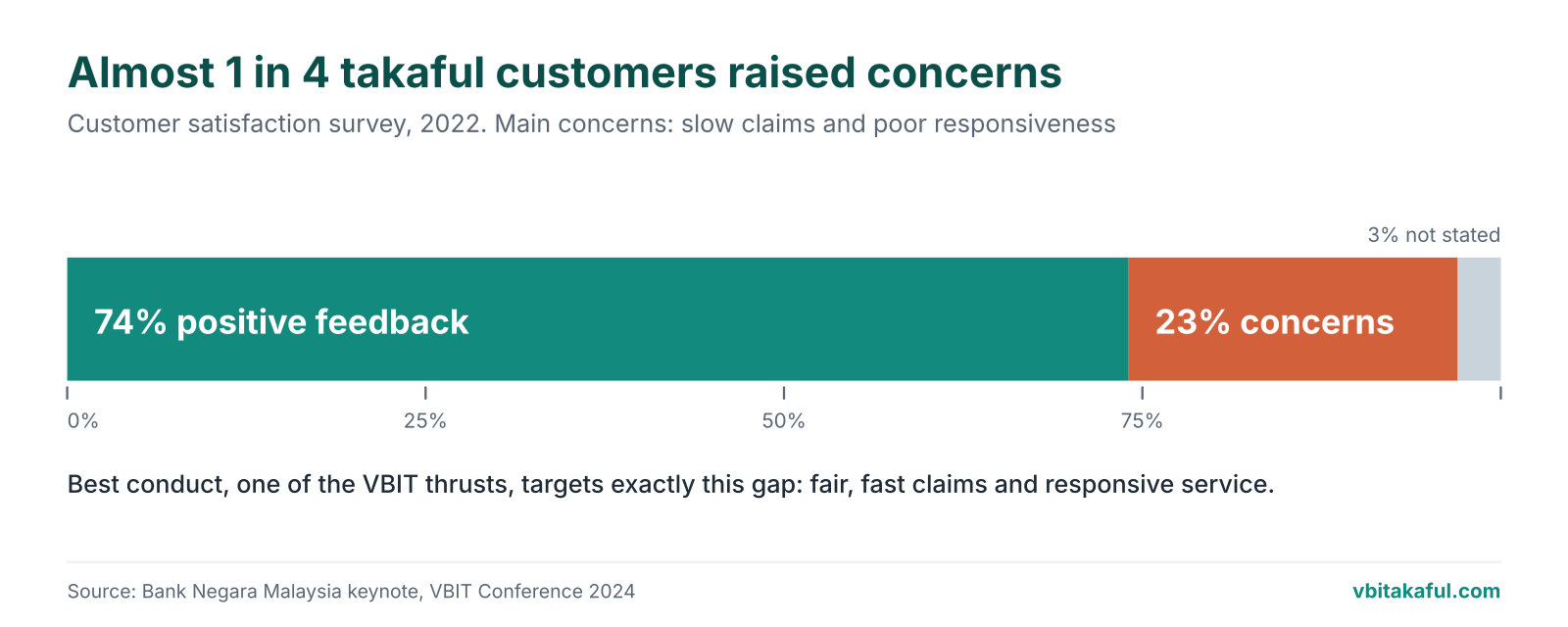
Best conduct means treating participants fairly at every step, from sales to claims. BNM links it to the Islamic principles of amanah (trust) and ihsan (excellence). It matters because service is still a weak spot: in a 2022 industry survey, 74% of customers were positive, but 23% raised concerns, mainly slow claims and poor responsiveness.
A fifth thrust? Capacity building
Some operators, including Sun Life Malaysia Takaful and Hong Leong MSIG Takaful, list capacity building as a fifth thrust. It covers training staff and agents so they can deliver the other four. MTA launched a VBIT Training Module in October 2024 to support this.
The four focus areas
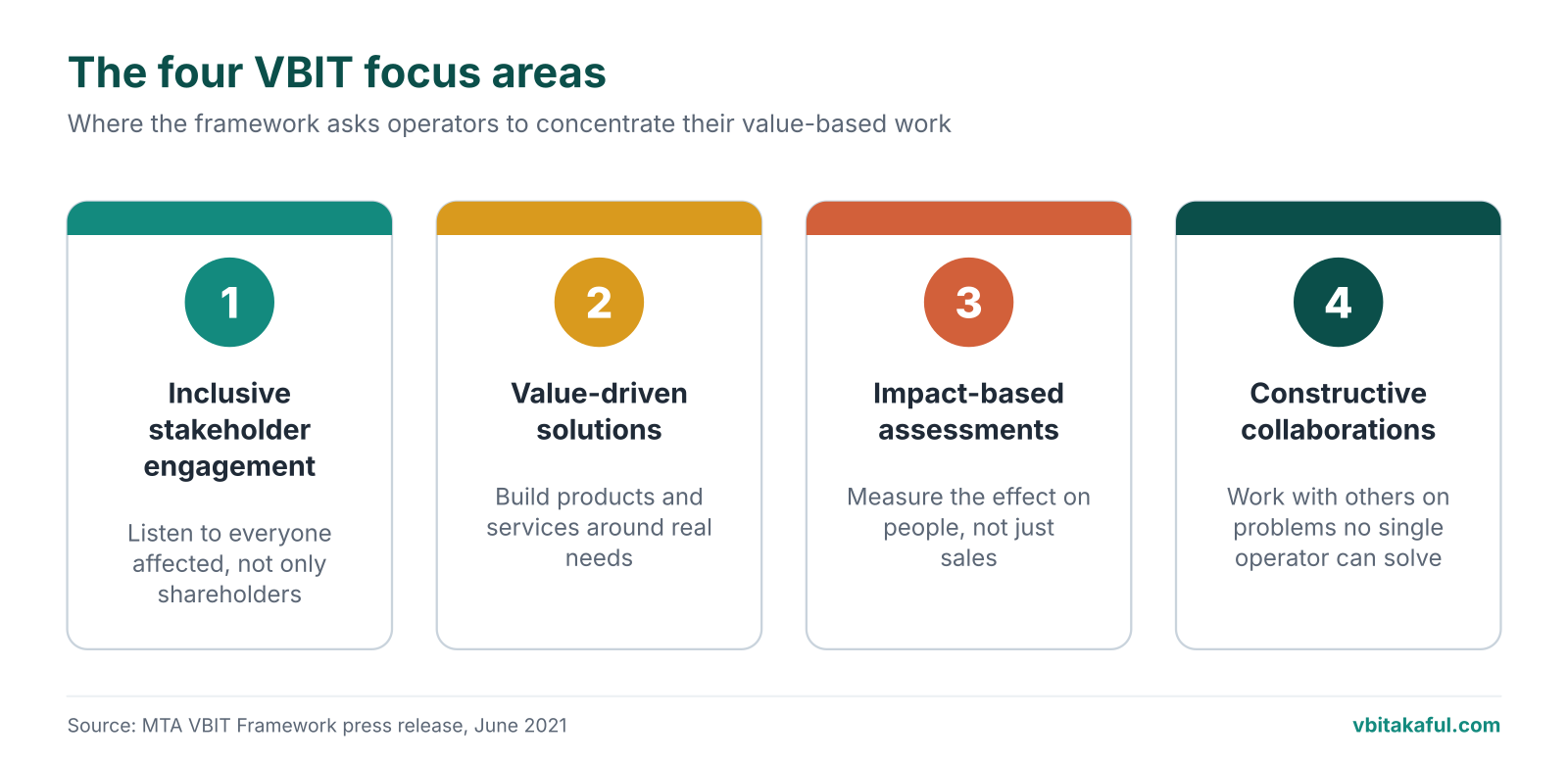
There are many ways to put value-based ideas into practice. The framework prioritises four focus areas:
| Focus area | What it means | Example of what it looks like |
|---|---|---|
| Inclusive stakeholder engagement | Listening to everyone affected, not only shareholders | Consulting participants, agents, regulators and communities before designing products |
| Value-driven solutions | Products and services built around real needs | Low-cost plans for low-income groups, simple claims, Shariah features such as wakaf |
| Impact-based assessments | Measuring the effect on people and society, not just sales | Tracking who gets covered and how claims help them recover |
| Constructive collaborations | Working with others to solve problems no single operator can | Industry-wide programmes with MTA, BNM, government agencies and universities |
The industry also committed to reporting the progress and effectiveness of its value-based initiatives to the public and stakeholders. The tools for that came later, through the VBIT Roadmap.
How operators adopt VBIT: Corporate Value Intent
Each operator is encouraged to write its value-driven strategy into its Corporate Value Intent (CVI), vision and mission. The CVI is a short statement of the value the company intends to create, and it guides culture and decisions from the top.
Adoption is meant to happen in stages. The framework expects initiatives to roll out gradually, shifting mindsets and encouraging innovation over time rather than all at once.
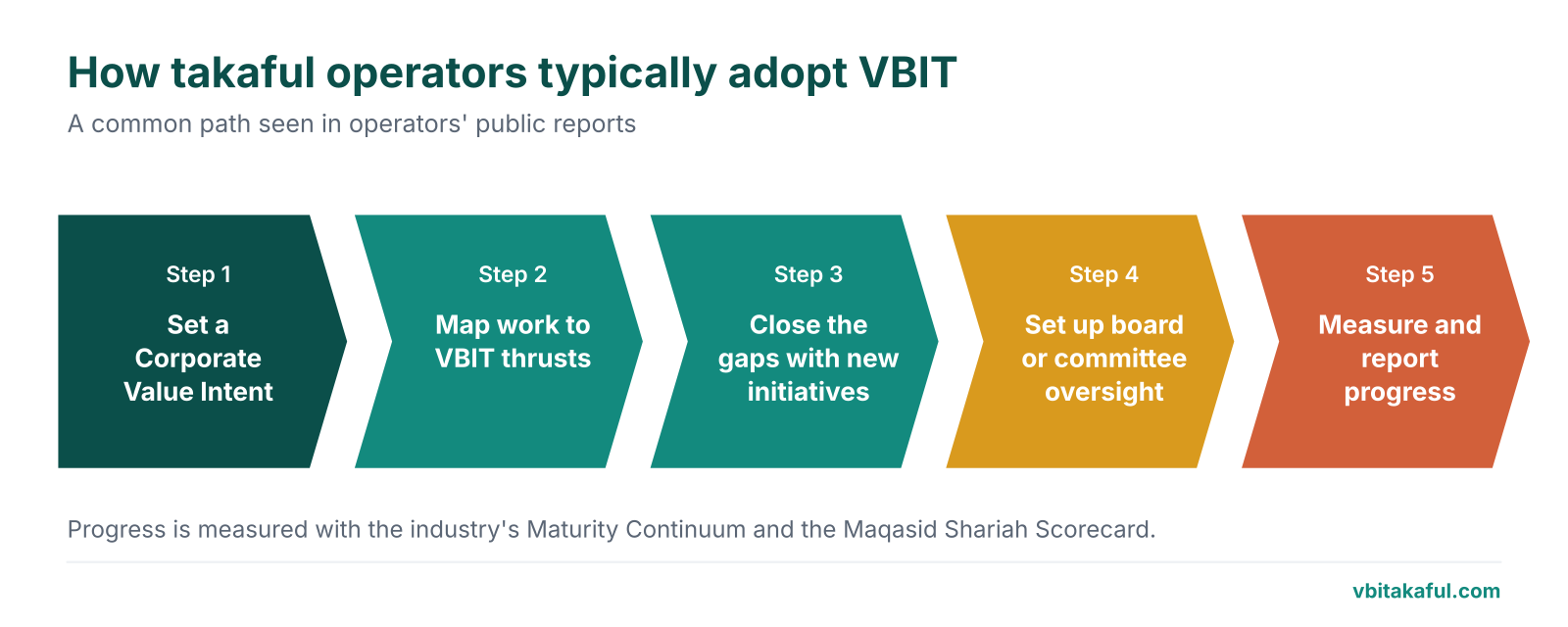
In practice, operators that adopt VBIT tend to follow the same path:
- Set a Corporate Value Intent that names the outcomes the company wants to create.
- Map existing products, investments and community work to the VBIT thrusts.
- Close gaps with new initiatives, such as low-cost plans, sustainable investing or better claims service.
- Set up oversight, often a board or management committee for VBI and sustainability.
- Measure progress and report it, using the industry’s Maturity Continuum and the Maqasid Shariah Scorecard.
Sun Life Malaysia Takaful, for example, says it weighs three aspects when it implements VBIT: Shariah principles, positive impact and sustainable returns.
One point is often missed: VBIT is voluntary. Operators do not have to follow it, although MTA encourages all its members to adopt it over time.
VBI vs VBIT vs ESG: how they compare
VBIT overlaps with VBI and ESG, but it is not the same thing. The key difference from ESG is that VBIT puts Shariah at the centre of every decision.
| VBI | VBIT | ESG | |
|---|---|---|---|
| Introduced by | Bank Negara Malaysia with Islamic banks | Malaysian Takaful Association | Global investors and reporting bodies |
| Year | 2017 | 2021 | 2000s onward |
| Applies to | Islamic banks | Takaful and retakaful operators | Any company or investor |
| Starting point | Maqasid al-Shariah | Maqasid al-Shariah | Environmental, social and governance risks |
| Pillars | Entrepreneurial mindset, community empowerment, good self-governance, best conduct | Financial resilience, community empowerment, good self-governance, best conduct (some add capacity building) | Environmental, social, governance |
| Measurement tools | VBI Financing and Investment Impact Assessment Framework (VBIAF), VBI scorecard | Maturity Continuum (2022), Maqasid Shariah Scorecard (2024) | Many standards and ratings |
| Shariah’s role | Core | Core | Not part of the concept |
| Binding? | Adopted by each bank based on readiness | Voluntary | Depends on the jurisdiction and rules |
VBIT also lines up with global goals. MTA aligned the framework with the UN Sustainable Development Goals and the UNEP Finance Initiative’s Principles for Sustainable Insurance.
VBIT in practice: what operators are doing
Several Malaysian takaful operators now say publicly how they apply VBIT. These examples come from their own websites and reports.
| Operator | What they report | VBIT thrust it supports |
|---|---|---|
| Etiqa | A VBI and Sustainability Steering Committee meets monthly; iTEKAD Protection subsidises yearly contributions for micro-entrepreneurs, delivery riders and gig workers | Community empowerment, good self-governance |
| Sun Life Malaysia Takaful | Corporate Value Intent built on financial security, sustainable investing and healthier lives; MySinarKasih adds a free wakaf benefit to takaful cover (2026) | Financial resilience, community empowerment |
| Zurich Takaful | Uses the VBIT framework to manage sustainability risks and initiatives in its takaful business | Good self-governance |
| Prudential BSN Takaful | Maps inclusive offerings and financial literacy work to VBIT thrusts and the UN SDGs | Financial resilience, community empowerment |
| Hong Leong MSIG Takaful | Transforming product and service delivery along its VBIT maturity continuum, including digital-first plans | All five thrusts |
Across the industry, takaful operators also contributed RM52.25 million in zakat during 2025 to support community development.
What VBIT means for you as a takaful participant
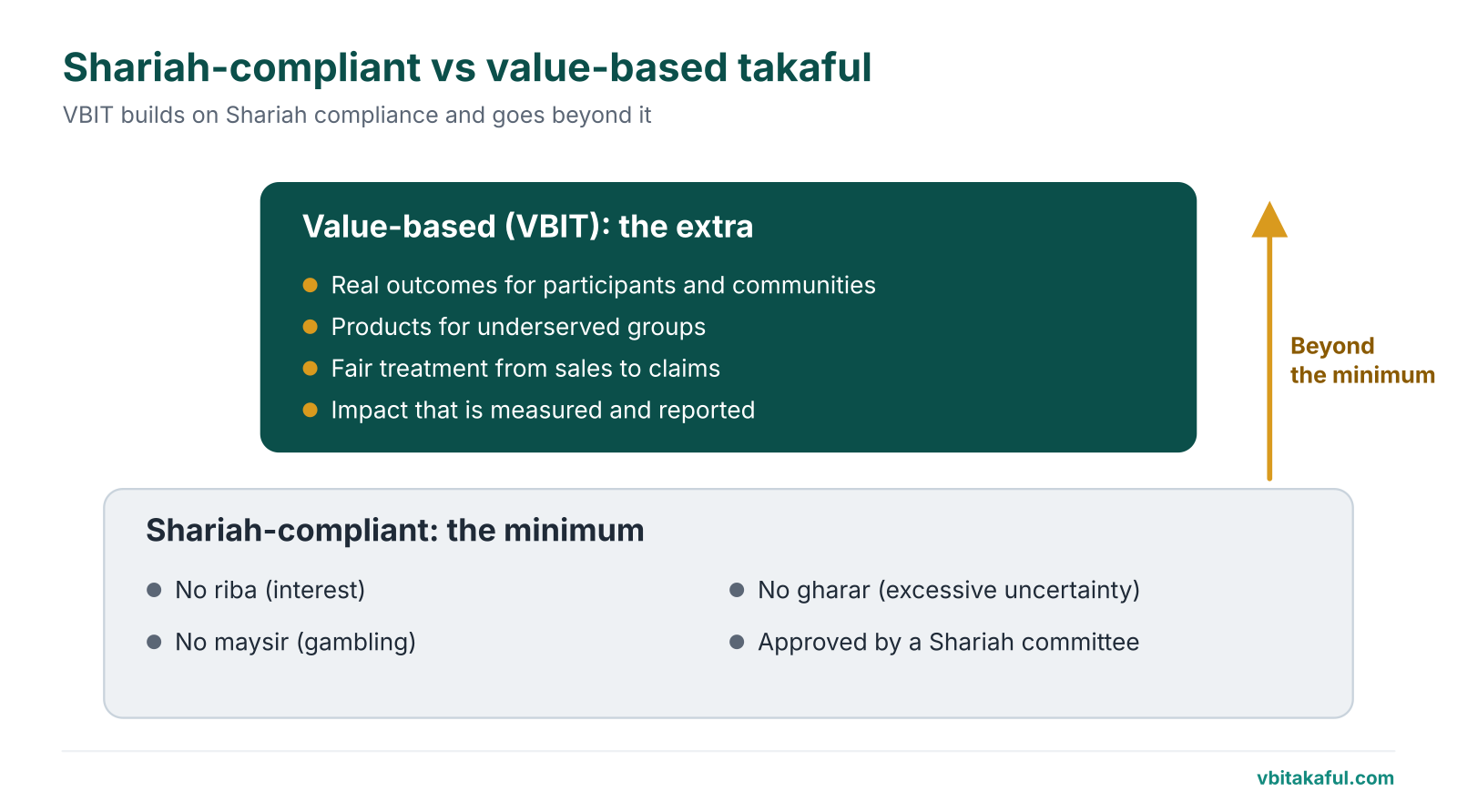
Most people buy takaful so they are covered when something goes wrong. VBIT asks takaful companies to go one step further: a product should not only be Shariah-compliant, it should actually do good for you, your family and your community.

Think of a halal-certified restaurant. Halal certification is the minimum. A good halal restaurant is also honest about prices, treats customers fairly and looks after its neighbourhood. VBIT is about that extra.
The thrusts in everyday terms
- Financial resilience = bouncing back. A hospital stay or a flood should not drain your savings or push you into debt.
- Community empowerment = reaching people usually left out. Gig workers, hawkers and low-income families should be able to find cover they can afford.
- Good self-governance = the company polices itself. It manages your contributions as a trustee, not just as a seller.
- Best conduct = fair treatment. Clear explanations, no pressure selling, and claims handled properly and on time.
- Capacity building = better-trained people. Agents and staff who understand both the product and their duty to you.
What VBIT does not do
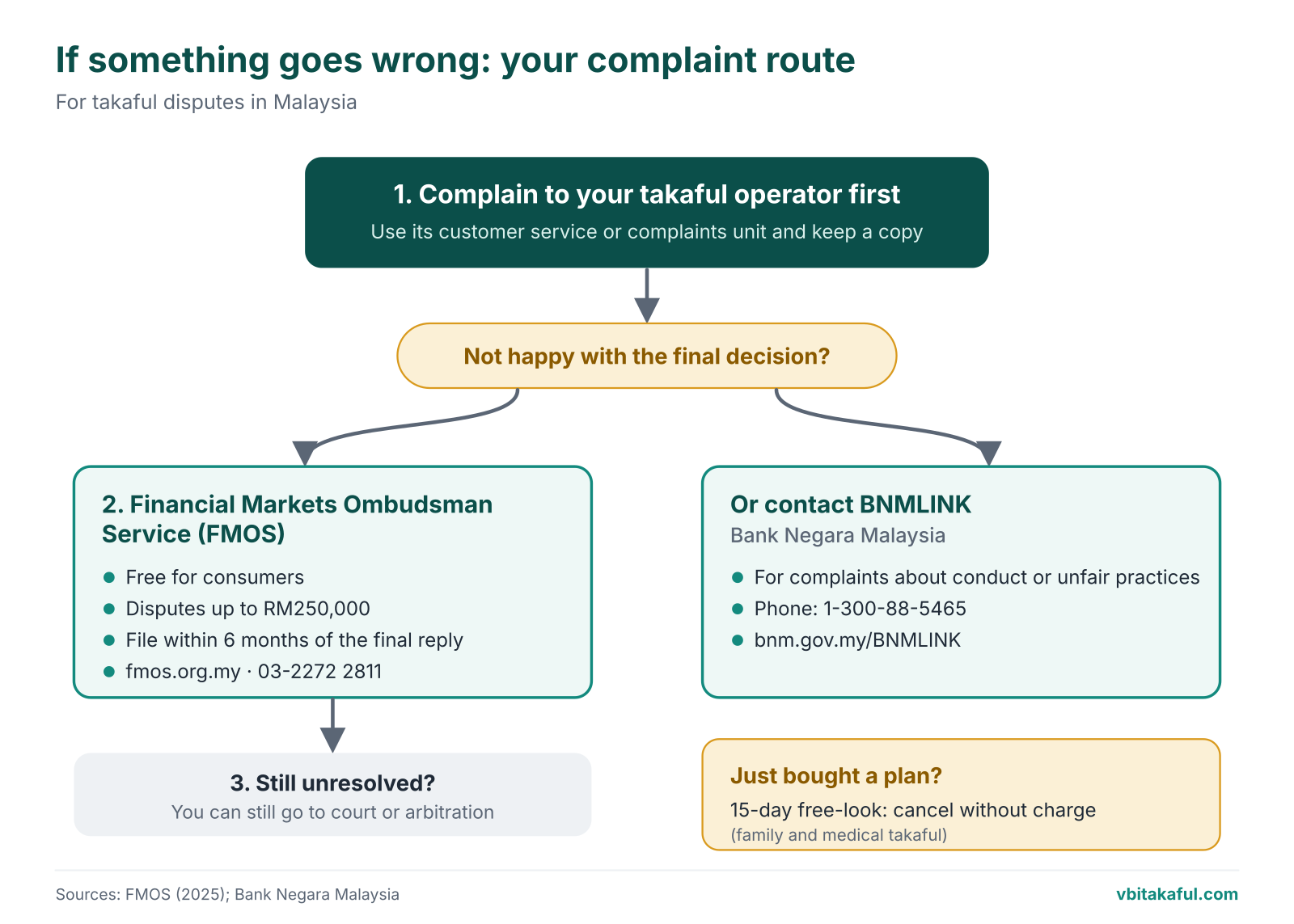
VBIT does not change your contract, and it is not a guarantee. Your rights come from your takaful certificate, the Product Disclosure Sheet and Bank Negara’s rules. These are the protections you can rely on:
- 15-day free-look period. For family and medical takaful, you can cancel within 15 days of receiving your certificate and not be charged.
- Complain to your operator first. If you are unhappy with its final answer, take the dispute to the Financial Markets Ombudsman Service (FMOS), which replaced the Ombudsman for Financial Services on 1 January 2025.
- FMOS is free. It handles disputes involving direct financial losses of up to RM250,000. You have six months from the operator’s final reply to file.
- You can also contact BNMLINK, Bank Negara’s contact centre, on 1-300-88-5465.
Questions to ask before you sign up

- Who is this plan for, and can I afford it every month, not just this month?
- Can you explain it in simple words? Ask for the Product Disclosure Sheet and read it.
- How do claims work, and how long do they usually take?
- Does it do any good beyond protecting me, such as a wakaf or hibah feature?
- Does the company publish a sustainability or VBIT report?
- Is the operator licensed by Bank Negara Malaysia? You can check on BNM’s website.
This guide is general information, not financial advice. Always read your certificate and Product Disclosure Sheet before you buy.
Where VBIT stands in 2026
Five years after launch, VBIT has moved from a concept paper to a set of working tools. In 2023, BNM still described the industry as being at the early stages of putting VBIT into practice. Since then, the main building blocks have arrived:
| Date | Milestone |
|---|---|
| October 2022 | VBIT Roadmap launched, turning the framework into action plans and targets |
| October 2024 | Maqasid Shariah Scorecard and VBIT Training Module launched at the VBIT Conference 2024 |
| November 2024 | MTA’s Hijrah27 strategic plan launched, aligned with VBIT |
| October 2025 | Maqasid Shariah Scorecard handed over to ISRA, the International Shariah Research Academy for Islamic Finance |
| April 2026 | MTA’s 2025 Financial Sector Blueprint and Sustainability Report reports more than 30 initiatives aligned with VBIT |
BNM’s current message to the industry focuses on three things: offer a wider and more inclusive range of protection, raise conduct to Shariah standards, and report impact clearly against defined outcomes.
For the targets, the Maturity Continuum and how progress is measured, read our guide to the VBIT Roadmap.
Frequently asked questions
What does VBIT stand for?
VBIT stands for Value-Based Intermediation for Takaful. It is the takaful industry’s version of Bank Negara Malaysia’s Value-Based Intermediation (VBI) approach for Islamic banks.
Who issued the VBIT Framework?
The Malaysian Takaful Association (MTA) issued it on 23 June 2021, after consulting its member takaful and retakaful operators and other stakeholders.
Is VBIT mandatory for takaful operators?
No. VBIT is a voluntary industry framework, not a BNM regulation. MTA encourages all members to adopt it over time.
What are the VBIT thrusts?
The framework names four: financial resilience, community empowerment, good self-governance and best conduct. Some operators add capacity building as a fifth.
How is VBIT different from ESG?
Both aim for positive environmental and social impact. VBIT starts from Maqasid al-Shariah and puts Shariah at the core of every decision; ESG does not.
Does VBIT apply to conventional insurance?
No. VBIT covers family takaful, general takaful and retakaful operators only.
Is VBIT the same as being Shariah-compliant?
No. Shariah compliance is the minimum. VBIT asks operators to go further and make sure their products and conduct actually benefit people and society.
Do I pay more for a VBIT-aligned plan?
No. VBIT is not a charge or an add-on. What you pay depends on the plan you choose.
Where can I get the official VBIT Framework document?
From the Malaysian Takaful Association, through its website takaful4all.org.
Sources and further reading
- Bank Negara Malaysia / MIFC: VBIT Framework press release (June 2021)
- Malaysian Takaful Association: Annual Report 2022, Development of the Takaful Industry
- BIS: BNM Deputy Governor’s speech at the VBI Dialogue (2017)
- BNM: Keynote at Takaful Rendezvous 2023
- BIS: BNM keynote at the VBIT Conference 2024
- Bernama: MTA unveils Maqasid Shariah Scorecard (2024)
- Bernama: MSS handover to ISRA at GIFF 2025
- Newswav: MTA 2025 Financial Sector Blueprint and Sustainability Report (2026)
- Salaam Gateway: VBIT framework coverage (2021)
- BNM: Medical and health takaful FAQ (free-look period)
- FMOS: Financial Markets Ombudsman Service brochure (2025)
- Berita Harian: Takaful industry zakat contribution in 2025