

What is the VBIT Roadmap?
The VBIT Roadmap is the Malaysian takaful industry’s action plan for putting the VBIT Framework into practice. The Malaysian Takaful Association (MTA) launched it in October 2022, alongside the Global Islamic Finance Forum 2022. The Framework explains what value-based takaful is; the Roadmap sets out how the industry gets there, with targets, initiatives and a way to measure progress.
| At a glance | |
|---|---|
| Full name | Value-Based Intermediation for Takaful (VBIT) Roadmap |
| Issued by | Malaysian Takaful Association (MTA) |
| Launched | October 2022 |
| Builds on | VBIT Framework, June 2021 |
| Main targets | Takaful penetration above 19%; the whole industry embracing VBIT by 2025 |
| Key tool | The Maturity Continuum, a self-assessment for operators and the industry |
| Aligned with | Bank Negara Malaysia’s Financial Sector Blueprint 2022–2026 |
| Later additions | Maqasid Shariah Scorecard (2024), Hijrah27 strategic plan (2024) |
About this guide: This is an independent explainer. It is not published by, or affiliated with, the Malaysian Takaful Association. For the official Roadmap document, contact MTA through takaful4all.org.
Framework vs Roadmap: what is the difference?
The Framework is the destination and the Roadmap is the route. At the launch, MTA’s chairman put it simply: the framework helps the industry understand VBIT, while the roadmap shows how to implement it.
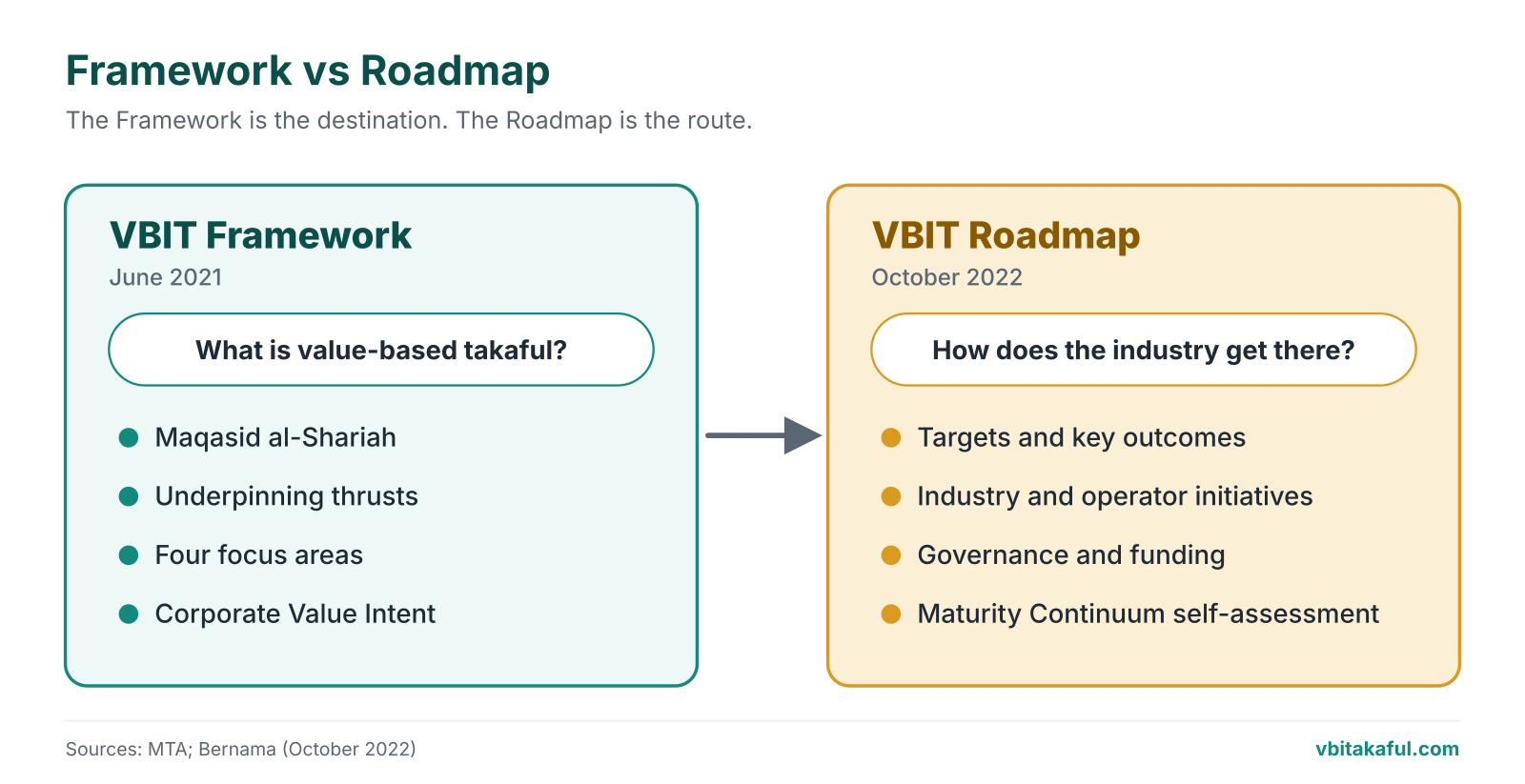
| VBIT Framework | VBIT Roadmap | |
|---|---|---|
| Launched | June 2021 | October 2022 |
| Answers | What is value-based takaful? | How does the industry get there? |
| Contents | Maqasid al-Shariah, underpinning thrusts, focus areas, Corporate Value Intent | Key outcomes, initiatives, targets, governance, Maturity Continuum |
| Level | Principles for every operator | Action plans at industry and operator level |
| Measures progress? | Commits to reporting progress | Introduces the self-assessment tool to do it |
The Roadmap also connected VBIT to Bank Negara Malaysia’s Financial Sector Blueprint 2022–2026, which was published after the Framework. That link gave VBIT a place in the national plan for the financial sector.
Targets and timeline
The Roadmap set two headline goals. The first was to lift takaful penetration in Malaysia above 19%. The second was for the whole industry to embrace VBIT by 2025.
Those goals sit on a longer timeline that starts with Bank Negara’s VBI strategy paper and runs to MTA’s current Hijrah27 plan:
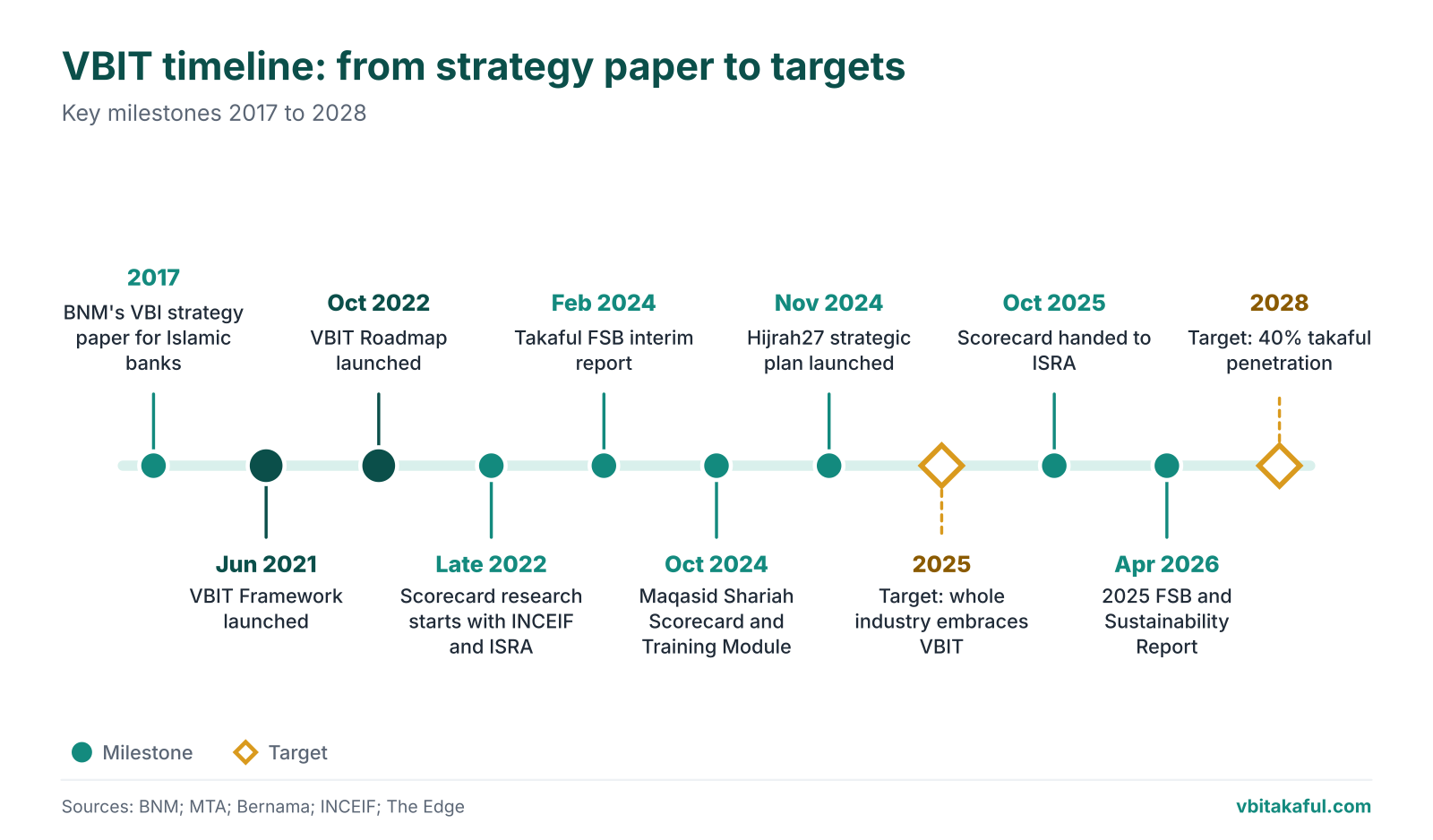
- 2017: BNM publishes its Value-Based Intermediation strategy paper for Islamic banks.
- June 2021: MTA launches the VBIT Framework.
- October 2022: MTA launches the VBIT Roadmap.
- Late 2022: MTA and INCEIF University start research on a Maqasid Shariah Scorecard.
- February 2024: MTA’s interim report on its Takaful FSB programme reviews progress against VBIT and its maturity continuum.
- October 2024: The Maqasid Shariah Scorecard and a VBIT Training Module launch.
- November 2024: MTA launches Hijrah27, its strategic plan to 2027, aligned with VBIT.
- 2025: Target year for the industry to embrace VBIT.
- October 2025: The scorecard is handed over to ISRA, the International Shariah Research Academy for Islamic Finance.
- April 2026: MTA’s combined 2025 Financial Sector Blueprint and Sustainability Report is published.
- 2028: MTA’s target year for 40% takaful penetration.
The building blocks: industry level vs operator level
The Roadmap works on two levels at once. MTA drives the shared, industry-wide work, and each takaful operator carries out its own initiatives. Both are tied to the same key outcomes and underpinning thrusts.
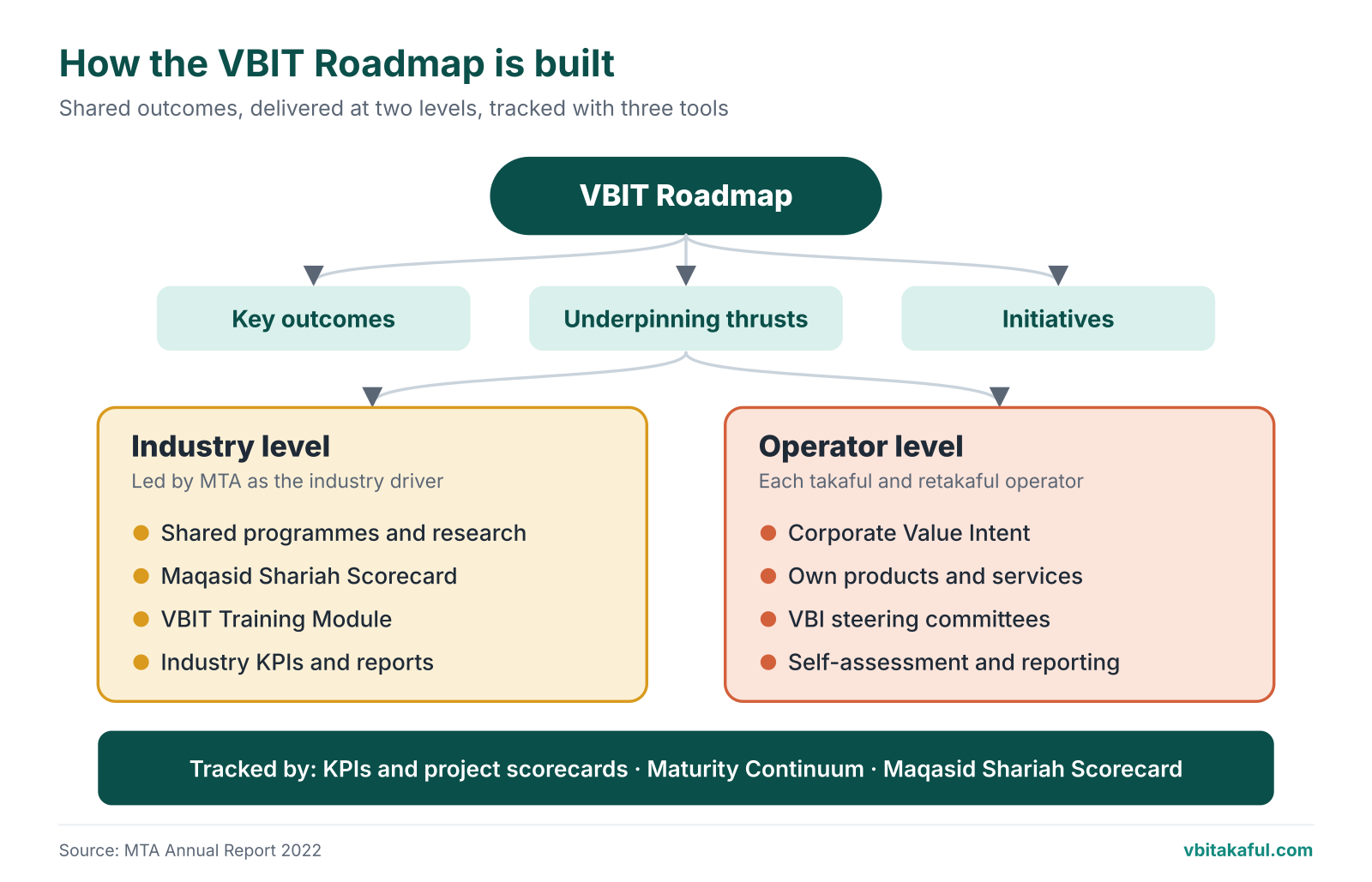
| Industry level | Operator level | |
|---|---|---|
| Who leads | MTA, as the industry driver | Each takaful and retakaful operator |
| What happens | Shared programmes, research, training and reporting | Own products, services, investments and community work |
| Examples | Maqasid Shariah Scorecard research, VBIT Training Module, industry reports | A Corporate Value Intent, low-cost plans, VBI steering committees |
| How progress is tracked | Industry KPIs and project scorecards | Self-assessment on the Maturity Continuum |
MTA’s 2022 annual report sums up the structure in three parts: initiatives and measures at both levels, KPIs and project management scorecards to formalise them, and the Maturity Continuum to let everyone check their own progress.
The Maturity Continuum: how operators check their progress
The Maturity Continuum is the Roadmap’s main measuring tool. It is a review exercise that operators and the industry use to keep track of how well they are delivering value through takaful.
MTA set criteria for each maturity level and each strategic class. An operator scores itself against those criteria, sees where it stands, and works on the gaps. Running the exercise again later shows whether it has moved up.
The cycle works like this:
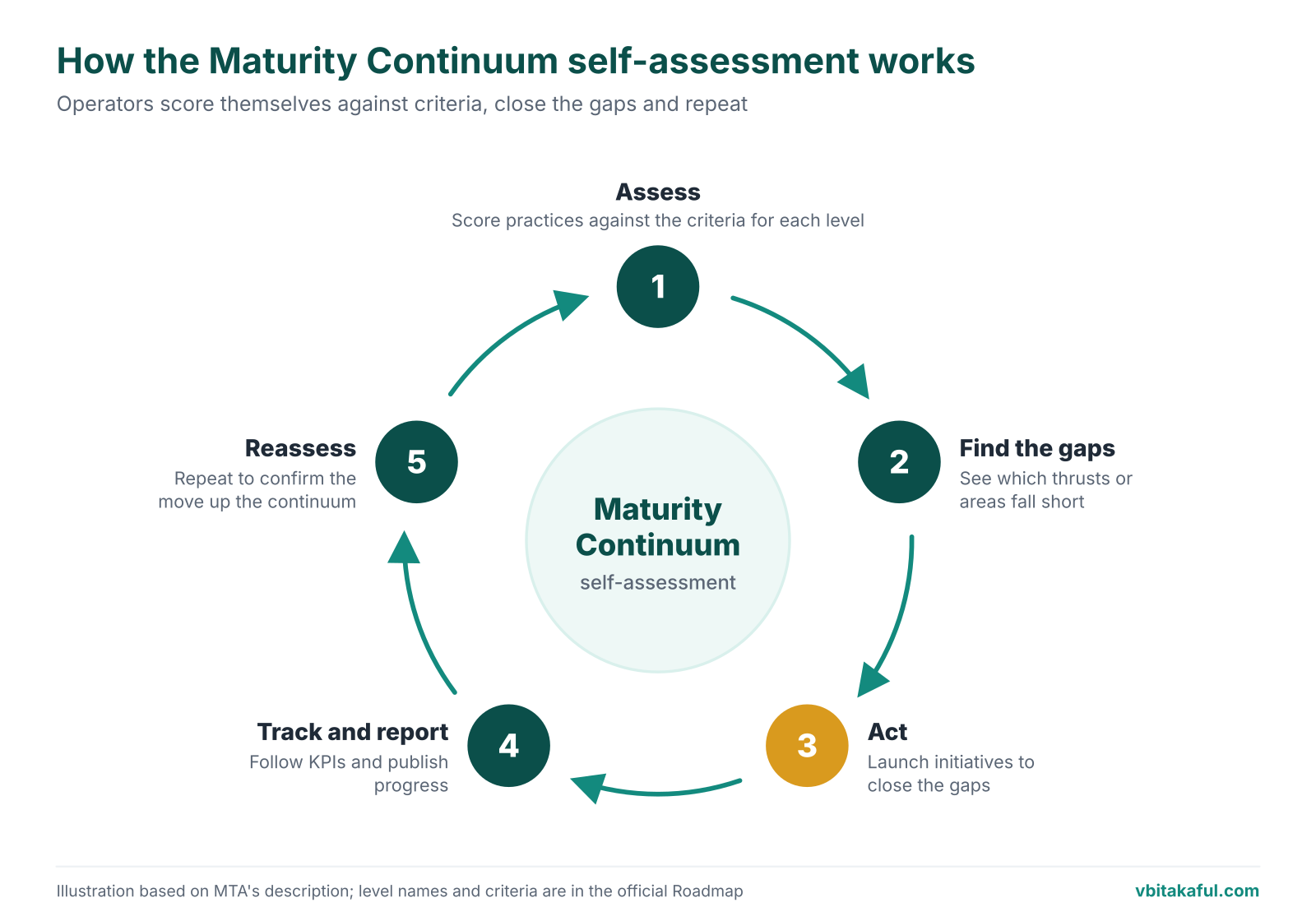
- Assess: score current practices against the criteria for each level.
- Find the gaps: see which thrusts or areas fall short.
- Act: launch initiatives to close those gaps.
- Track and report: follow KPIs and report progress.
- Reassess: repeat the exercise to confirm the move up the continuum.
The tool is used in practice. Hong Leong MSIG Takaful, for example, has said it is transforming its product and service delivery along its maturity continuum. MTA’s 2024 interim report on its Takaful FSB programme also measured the industry’s milestones against VBIT and the continuum.
The official names and criteria for each maturity level appear in the Roadmap document itself and are not reproduced here.
Governance and funding
MTA’s own review of national and industry roadmaps found that many deliver mixed results. It named two critical success factors for VBIT: a proper project governance structure, and the ability to assess achievements objectively.

The Roadmap’s answer has three parts:
- Oversight: MTA set up an industry-level FSB Steering Committee. It aligns VBIT initiatives with BNM’s Financial Sector Blueprint 2022–2026 and oversees delivery.
- A shared reference point: the committee identifies obstacles and opportunities. It also coordinates with stakeholders, BNM, government agencies and private institutions.
- Funding: the Fund4Cause VBIT Development Fund pays for VBIT action plans and initiatives. It is one of four industry development funds, alongside funds for social takaful, industry capacity building and takaful branding.
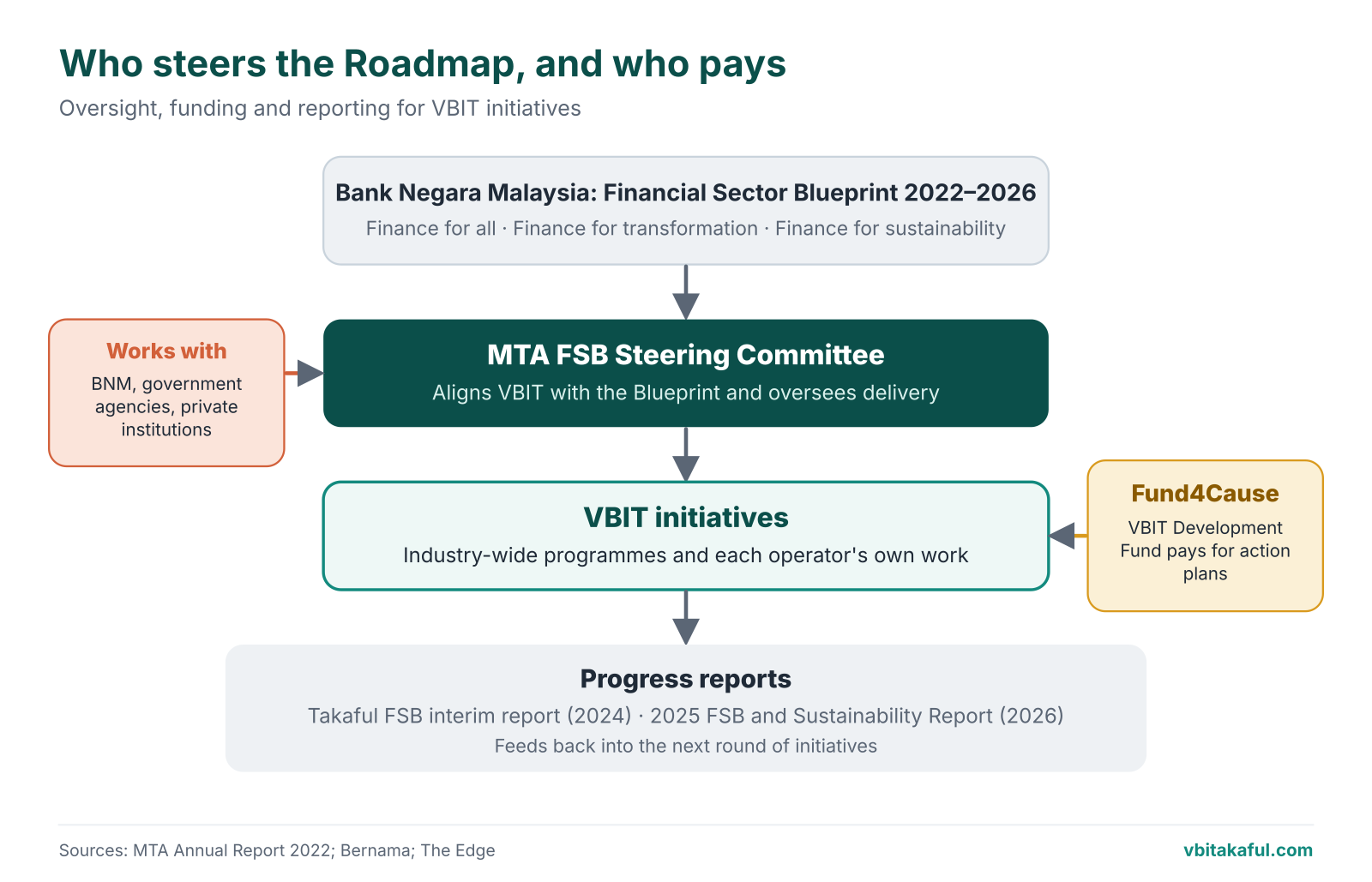
For regular progress reports, MTA now publishes a combined Financial Sector Blueprint and Sustainability Report for the takaful industry.
Measuring impact: the Maqasid Shariah Scorecard
The Maqasid Shariah Scorecard (MSS) measures whether takaful actually delivers the objectives of Shariah, not just whether it sells. MTA launched it on 15 October 2024 at the VBIT Conference 2024, and it is available to takaful operators on request through MTA.
It grew out of a practical problem. Operators told MTA they found it hard to choose measures and KPIs for VBIT. In November 2022, MTA began research with INCEIF University, through its ISRA Research Management Centre, with four objectives:
- Develop a scorecard to measure VBIT in light of Maqasid al-Shariah.
- Identify the key performance indicators for it.
- Introduce risk-weighted indicators for takaful.
- Measure the scorecard’s impact on selected business lines, offerings and products.
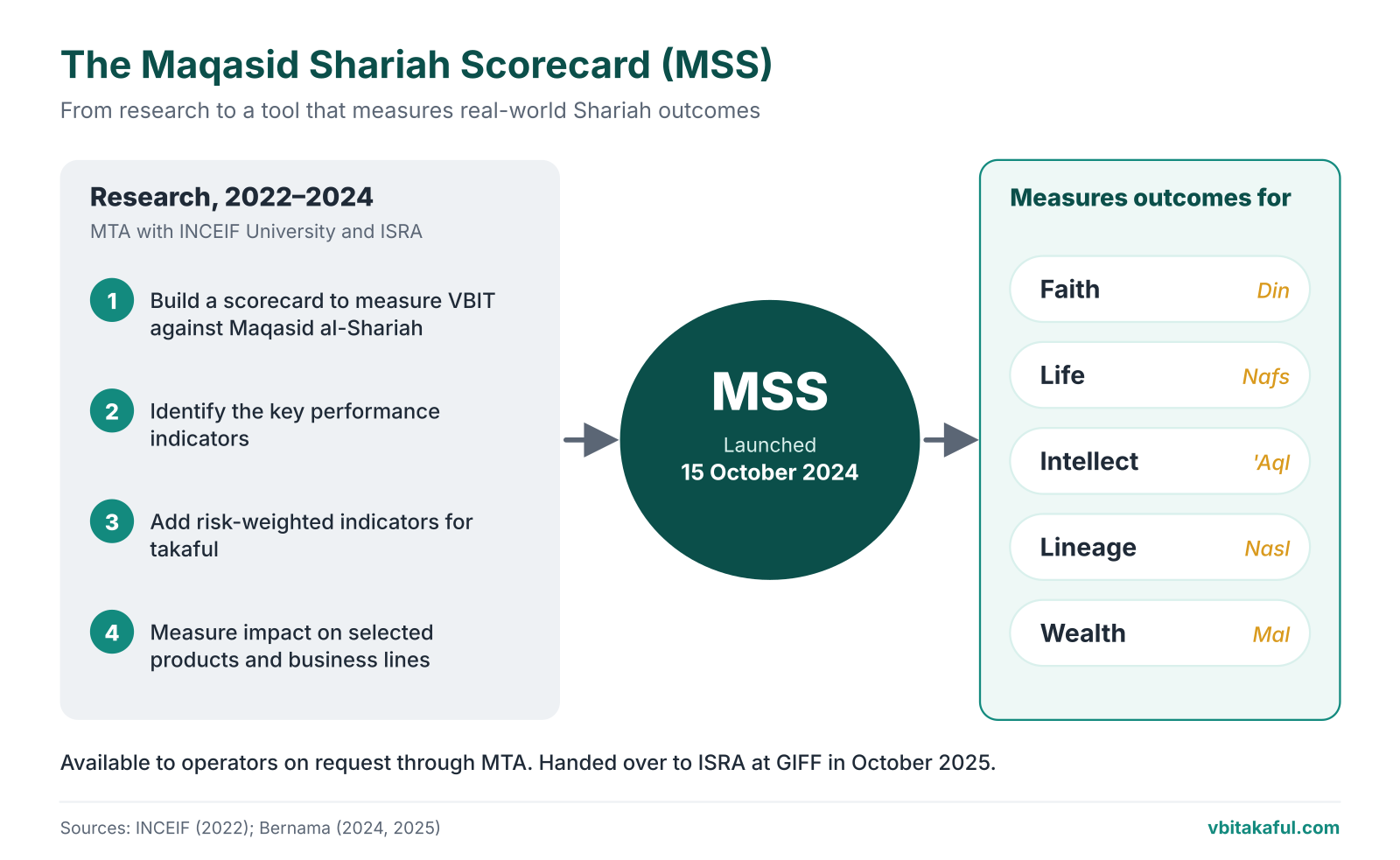
The scorecard links results back to the five Maqasid essentials: faith, life, intellect, lineage and wealth. It also sets a clear line between takaful and conventional insurance in terms of value and product design.
At the Global Islamic Finance Forum in October 2025, MTA handed the scorecard over to ISRA. MTA called it the industry’s first structured framework for measuring Shariah-based outcomes and social impact.
How the Roadmap fits Malaysia’s wider plans
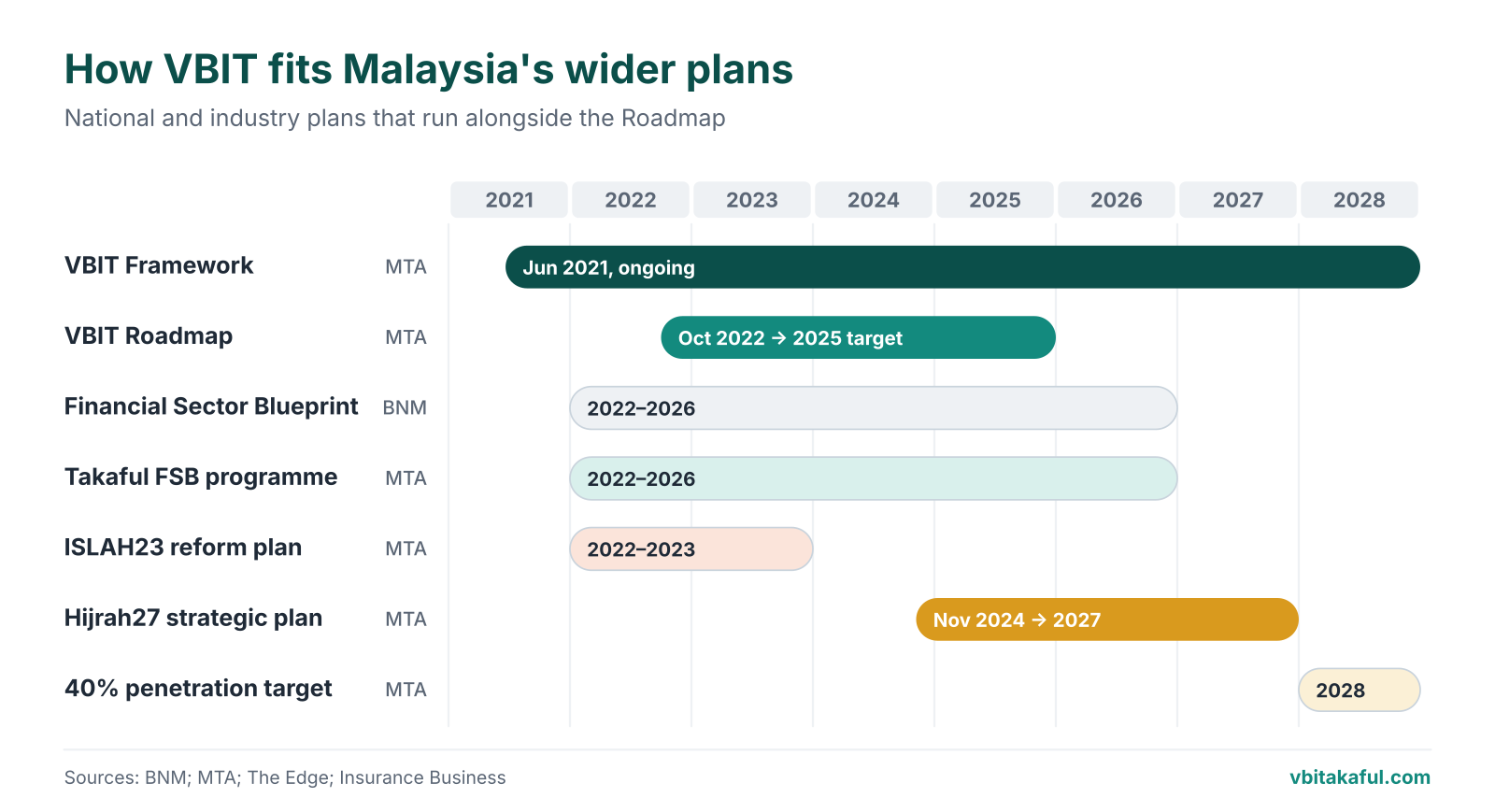
The VBIT Roadmap does not stand alone. It is one layer in a stack of national and industry plans that point in the same direction.
| Plan | Owner | Period | How it connects to VBIT |
|---|---|---|---|
| Financial Sector Blueprint (FSB) 2022–2026 | Bank Negara Malaysia | 2022–2026 | Sets the national outcomes the Roadmap aligns with: finance for all, finance for transformation and finance for sustainability |
| Takaful FSB programme | MTA | 2022–2026 | Harmonises BNM’s FSB targets with the VBIT Roadmap; reported in 2024 and 2026 |
| ISLAH23 reform plan | MTA | 2022–2023 | The industry reform plan that preceded Hijrah27 |
| Hijrah27 strategic plan | MTA | 2024–2027 | Builds on ISLAH23 and aligns with the FSB and VBIT; targets wider awareness, MSMEs and professionalism |
| UN Sustainable Development Goals | United Nations | To 2030 | The industry reports its initiatives against all 17 SDGs |
BNM has also pointed to bigger national plans as growth areas for value-based takaful. These include the National Energy Transition Roadmap, the New Industrial Master Plan, the halal ecosystem and SME financing.

Progress check: did the 2025 goals land?
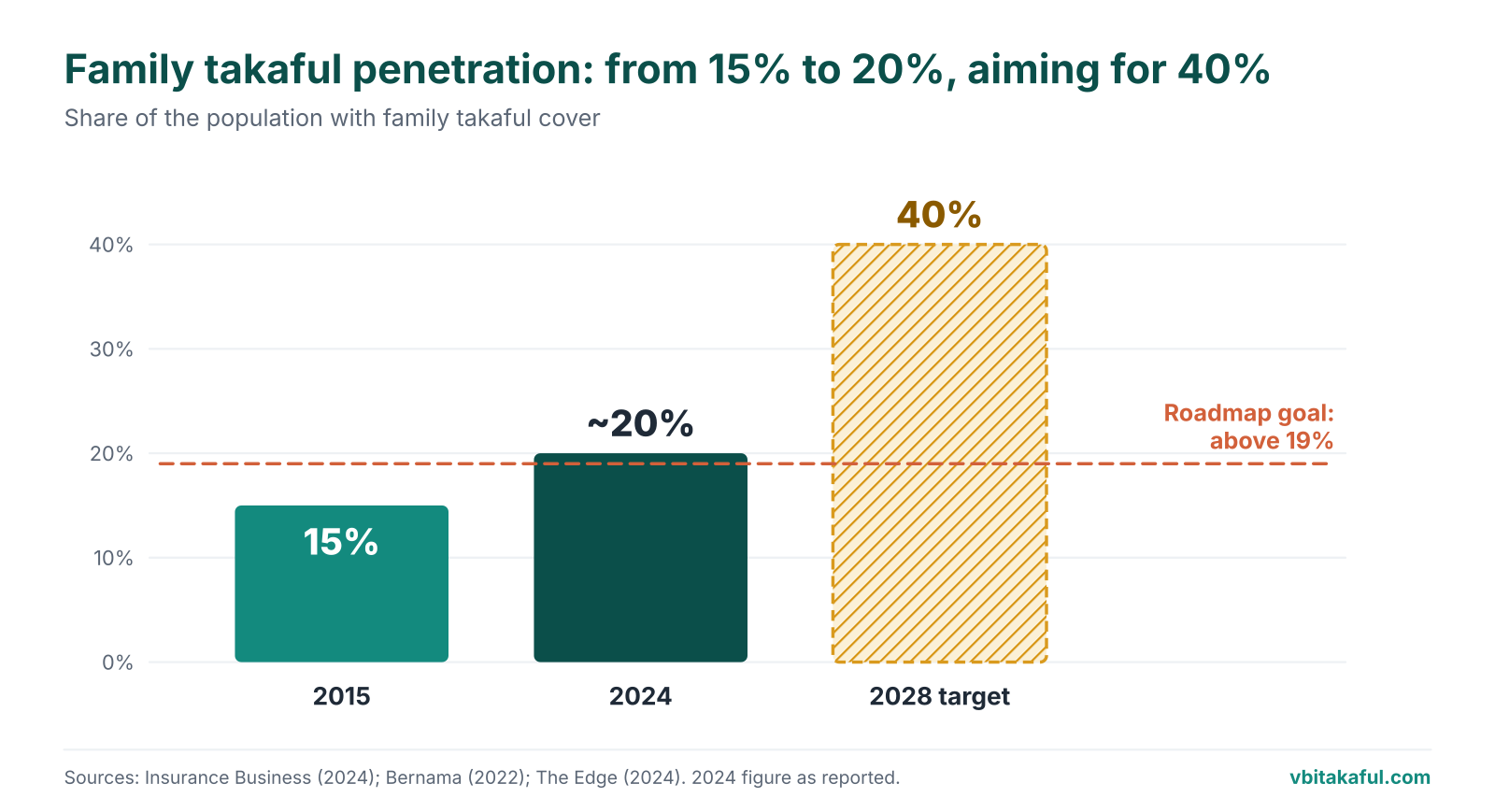
The penetration goal appears to have been met, but there is no public pass-or-fail verdict on the goal of full VBIT adoption. Family takaful penetration rose from 15% in 2015 to about 20% by 2024, above the Roadmap’s 19% mark. MTA has since raised its sights to 40% by 2028.
Other public numbers show the direction of travel:
- Over 30 initiatives implemented across five strategic thrusts since 2023, aligned with VBIT and contributing to all 17 SDGs (MTA, April 2026).
- Almost 970,000 people covered by microtakaful products in 2023 (BNM).
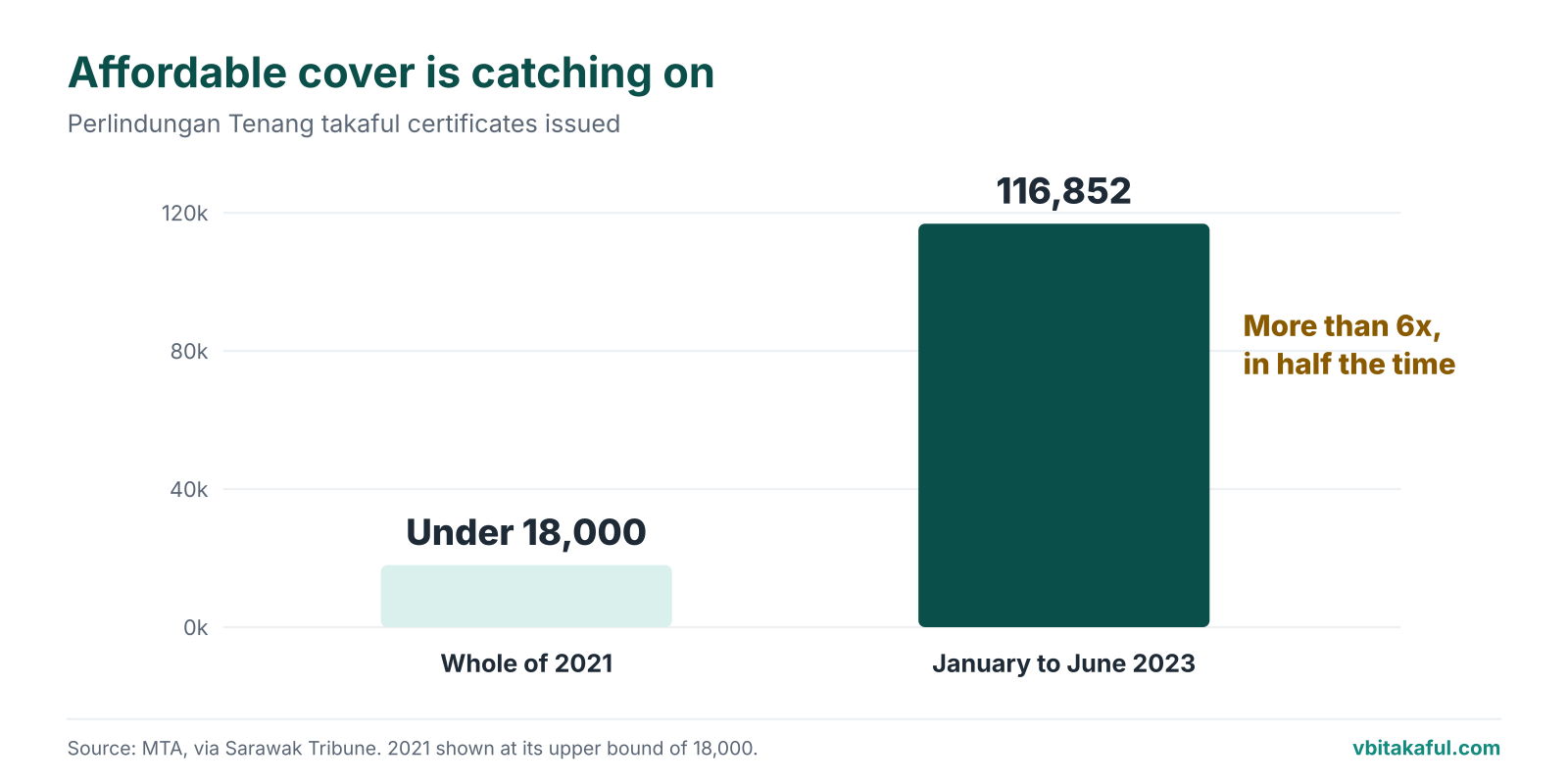
- 116,852 Perlindungan Tenang certificates issued in January to June 2023, against fewer than 18,000 in the whole of 2021 (MTA).
- RM52.25 million in zakat contributed by the takaful industry in 2025 (MTA).
- The first industry-level sustainability report in Malaysia’s financial sector, according to MTA (2026).
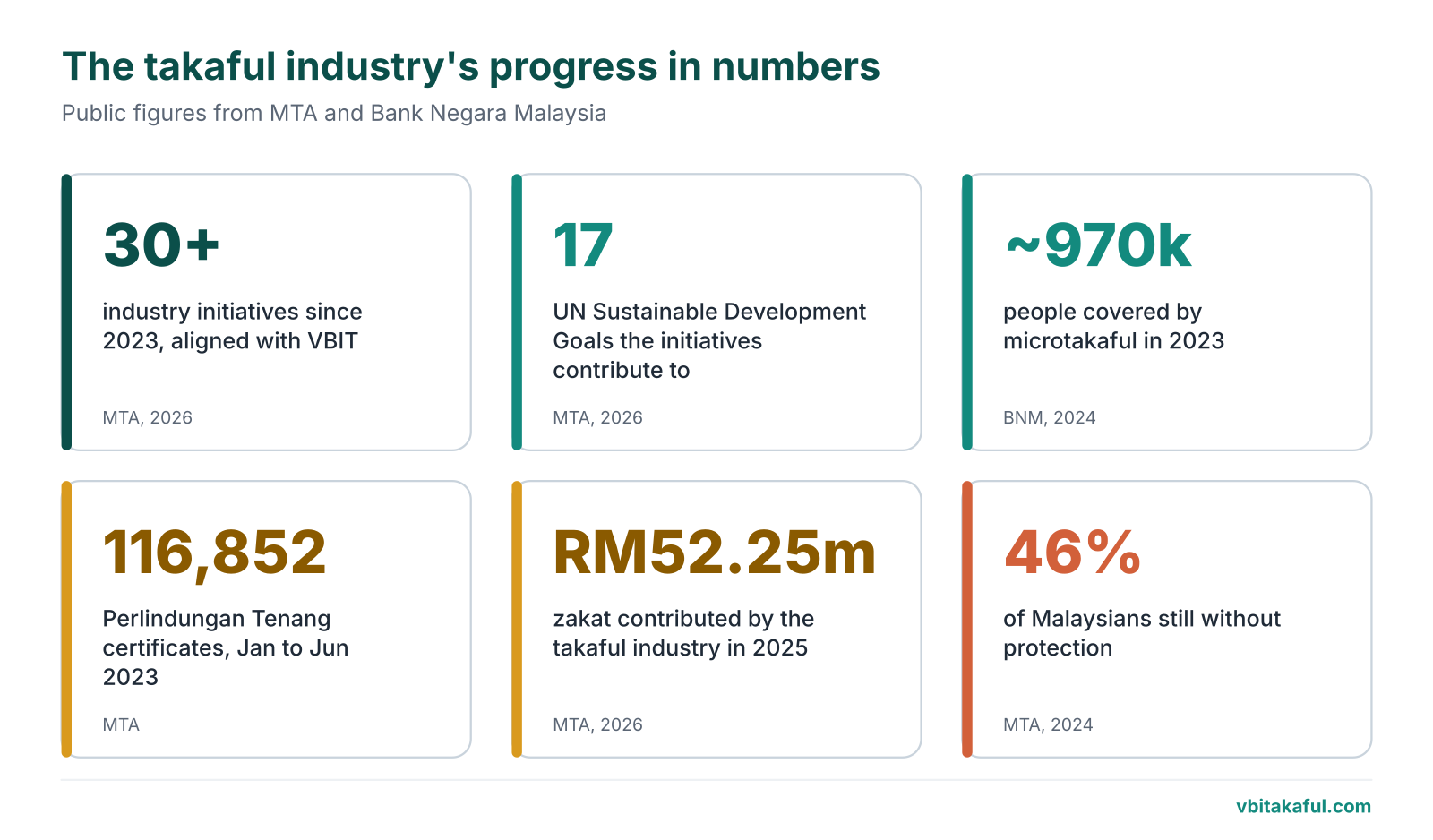
The gap is still large. MTA says 46% of Malaysians remain unprotected, and service is a weak spot: in a 2022 survey, 23% of customers raised concerns, mainly about slow claims.
What the Roadmap means for ordinary Malaysians
Why it matters to you
The Framework explains what good takaful looks like. The Roadmap is the plan to get there, with targets and deadlines. The main reason it exists is that many Malaysians still have no protection at all: MTA says 46% are unprotected.
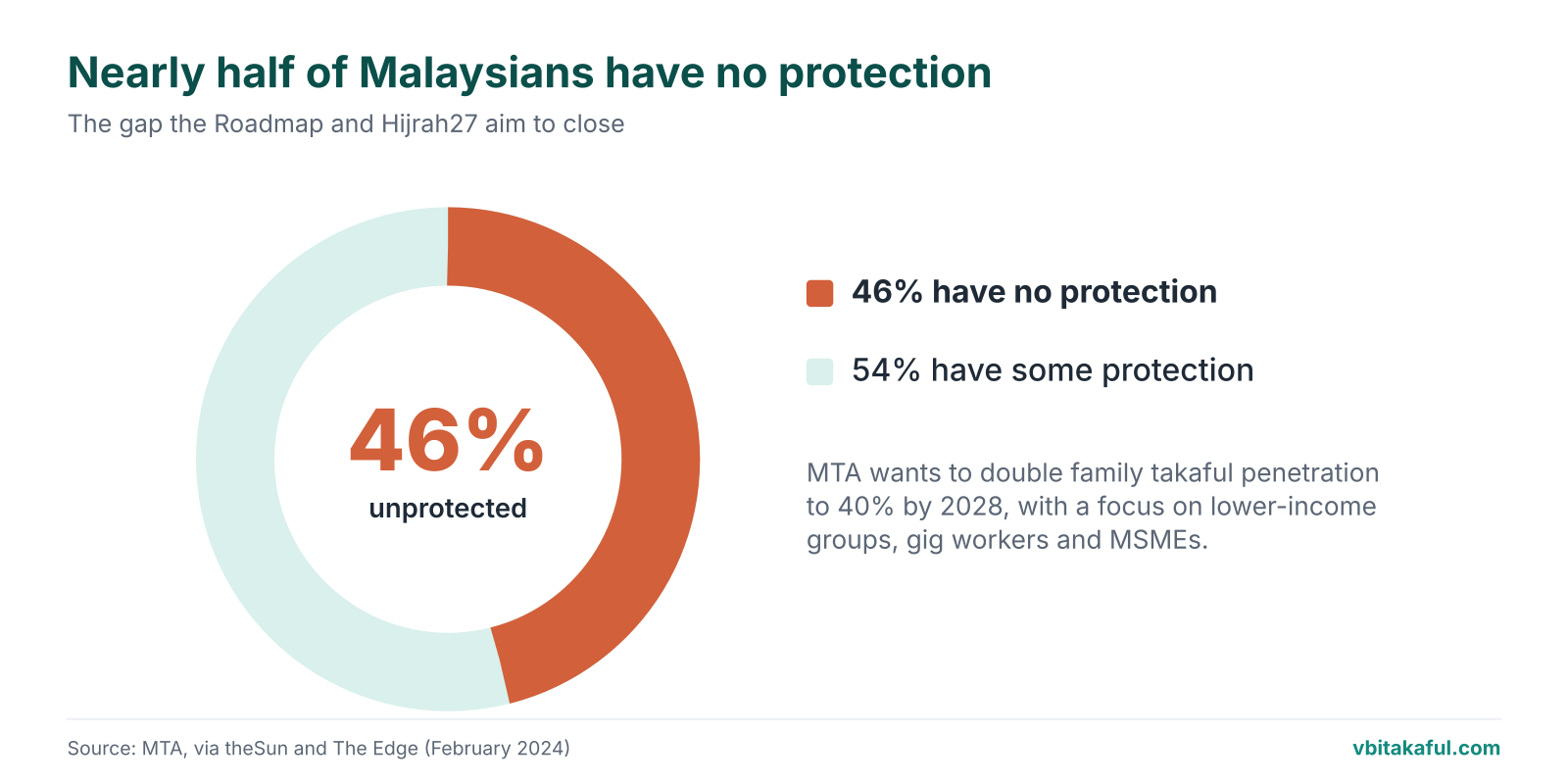
You will often see the phrase “penetration rate”. It simply means the share of people who have cover. For family takaful it has grown from 15% in 2015 to about 20%, and the industry wants 40% by 2028. For you, that means more plans built for people who usually get missed: the self-employed, gig workers, lower-income families and first-time buyers.
Changes you may notice

- Simpler, cheaper plans. Bank Negara’s Perlindungan Tenang initiative offers protection plans that are affordable, easy to understand and quick to claim on.
- Better-trained agents. New programmes such as PAMP and L.E.A.D. teach agency leaders about their duties to participants, Shariah principles and amanah.
- More money education. MTA is adding risk protection and takaful awareness to a personal-finance training programme for teachers.
- More use of hibah. Expanding hibah as a way to protect family wealth is one of the industry’s three priorities for 2026.
- Clearer impact reports. Operators are expected to show, with numbers, how their products help people.
The scorecards, explained simply
The Maturity Continuum is like a report card that companies give themselves. It shows how far along they are with VBIT and what they still need to fix. The Maqasid Shariah Scorecard goes further and checks whether takaful is actually improving people’s lives.
Both tools are for the companies, not for you. As far as public information shows, there is no rating you can look up for your own plan. The closest thing is your operator’s sustainability report.
If you already have takaful
Nothing in the Roadmap changes your existing certificate. It is still a good time to:

- Check whether your cover still fits your income, family size and medical costs today.
- Check your nominations or hibah, so the payout goes to the right people.
- Use the 15-day free-look period when you buy anything new, and read the documents in that time.
- Know where to complain: your operator first, then the Financial Markets Ombudsman Service (FMOS), which is free for disputes up to RM250,000.
This guide is general information, not financial advice. Always read your certificate and Product Disclosure Sheet before you buy.
Frequently asked questions
When was the VBIT Roadmap launched?
The Malaysian Takaful Association launched it in October 2022, alongside the Global Islamic Finance Forum 2022. It followed the VBIT Framework of June 2021.
What is the difference between the VBIT Framework and the VBIT Roadmap?
The Framework explains what value-based takaful is. The Roadmap sets out how to achieve it, with targets, initiatives, governance and a self-assessment tool.
What targets did the VBIT Roadmap set?
It aimed to lift takaful penetration above 19% and for the whole industry to embrace VBIT by 2025.
What is the VBIT Maturity Continuum?
It is a self-assessment tool. Operators and the industry score themselves against criteria for each maturity level and strategic class, then work to close the gaps.
What is the Maqasid Shariah Scorecard?
It is a tool that measures whether takaful delivers the objectives of Shariah and real social impact. MTA launched it in October 2024 after research with INCEIF University and ISRA.
How does Hijrah27 relate to VBIT?
Hijrah27 is MTA’s strategic plan to 2027, launched in November 2024. It builds on the earlier ISLAH23 plan and aligns with both the Financial Sector Blueprint and VBIT.
Does the Roadmap change my takaful certificate?
No. Your rights still come from your certificate, the Product Disclosure Sheet and Bank Negara’s rules.
Where can I read the official VBIT Roadmap?
Contact the Malaysian Takaful Association through its website takaful4all.org.
Sources and further reading
- Bernama: MTA says VBIT Roadmap complements framework (October 2022)
- theSun: VBIT Roadmap launch coverage (October 2022)
- Middle East Insurance Review: MTA launches VBIT Roadmap
- Malaysian Takaful Association: Annual Report 2022, Development of the Takaful Industry
- INCEIF: MTA and INCEIF to develop a Maqasid-based scorecard (2022)
- BIS: BNM keynote at the VBIT Conference 2024
- Bernama: MTA unveils Maqasid Shariah Scorecard (2024)
- Bernama: MSS handover to ISRA at GIFF 2025
- The Edge: MTA targets 40% takaful penetration by 2028
- Insurance Business: MTA launches Hijrah27
- Bernama: MTA unveils 2025 blueprint and takaful sustainability report (2026)
- Newswav: MTA 2025 Financial Sector Blueprint and Sustainability Report (2026)
- BNM: Keynote at Takaful Rendezvous 2023
- BNM: Perlindungan Tenang
- Sarawak Tribune: Perlindungan Tenang take-up
- theSun: 46% of Malaysians unprotected
- Berita Harian: MTA priorities for 2026